

Native Americans knew Jesus before missionaries arrived: The Texas Mystery
- Gurso
- Jan 17
- 8 min read

July 1629. The Texas Desert.
The history of Christian missions is filled with heroism, sacrifice, and martyrdom. We are used to reading about brave friars crossing impenetrable jungles, learning unknown languages, and often shedding their blood to bring the Cross to pagan lands. The logic has always been this: first the missionary arrives, then the Gospel arrives.But there is a case, buried in the archives of the Spanish Crown and the dossiers of the Inquisition, that completely flips this logic upside down. A unique case in history where prayer literally traveled faster than ships.
Picture the scene. We are in the unexplored territory between New Mexico and present-day Texas. A group of Franciscan missionaries, led by Father Juan de Salas, is pushing into lands where no European has ever dared to set foot. The atmosphere is tense. The heat is suffocating. The friars know that the tribe inhabiting these lands, the Jumanos, is a fierce, warrior people, potentially lethal for a handful of unarmed men dressed in rough habits.The fear is tangible. Every rustle among the cacti could be an ambush. The friars kiss their crucifixes, ready to offer their lives.
But when the encounter happens, the impossible occurs.The warriors emerge from the brush. They do not wear aggressive war paint; they do not nock arrows. They approach with reverential respect. And then, they do something that nearly makes the priests faint.The natives make the Sign of the Cross.Not a random gesture, but the precise sign: In the name of the Father, and of the Son, and of the Holy Spirit.Then they show objects. They are rudimentary rosaries, made of berries and cords, but unmistakable. Some pull out metal chalices that look like liturgical objects.The missionaries are shocked. They look at each other, in disbelief. How is this possible? The maps are blank.
No expedition has preceded them. According to all human logic, in that desert, Christ should be a totally unknown name.And yet, the Native Americans knew Jesus. They knew Him, they prayed to Him, and, even more incredibly, they were waiting for the priests.
"The Lady in Blue who comes from the sky"
Recovering from the shock, the friars asked through interpreters: “Who taught you all this? Who gave you these objects?”They perhaps expected to hear the story of a lost Spanish shipwreck survivor or a solitary explorer.But the tribal chief’s answer opened the doors to a supernatural mystery.“It was not a man,” the Jumanos said. “It was the Woman. The Lady dressed in blue.”
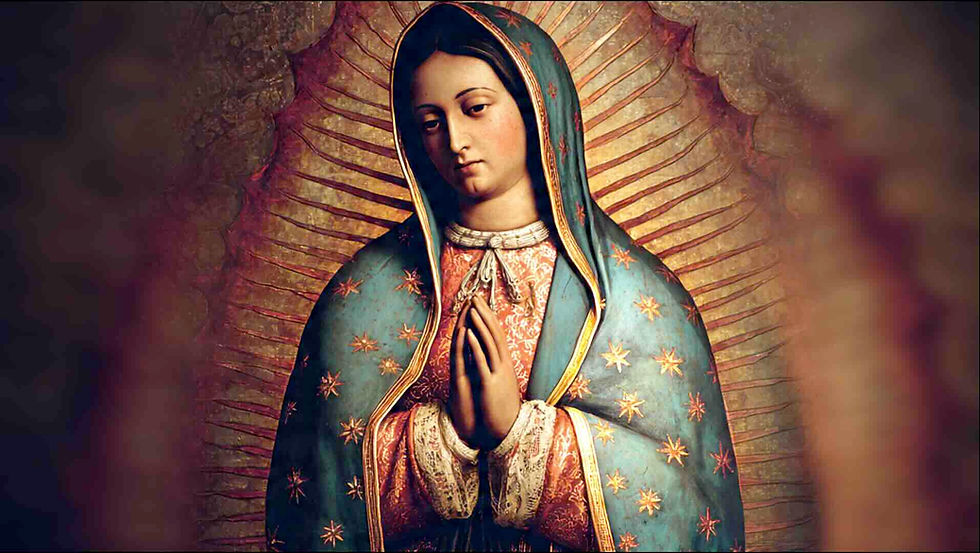
The natives recounted that, for some time, a young and beautiful woman, wrapped in a mantle the color of the sky, had been appearing to them regularly.She was not a frightening ghost, but a gentle and authoritative presence. She spoke in their language, the Tanoan dialects, and taught them the truths of the faith.She explained that there was only one true God, who had sent His Son to save all men. She taught them how to pray and told them to repent of their sins.But she didn’t stop at theory. The "Lady in Blue" had given them a practical prophecy: “Soon men will arrive dressed in brown like the earth, with cords at their waists. They will bring you the water that washes the soul (Baptism). Welcome them and listen to them.”
That is why the warriors had not attacked. They had recognized the "brown robes" prophesied by the Lady.The friars baptized thousands of indigenous people in just a few days. The work had already been done. They only had to "harvest" a crop that had been sown by an invisible hand.
Father Benavides' Investigation: Skepticism and Truth - Native Americans knew Jesus
News of this miraculous event reached the ears of Father Alonso de Benavides, the Custodian of the Missions of New Mexico. Benavides was a man of the church, but also a pragmatic administrator. He had to report to King Philip IV of Spain and Pope Urban VIII.He could not afford to write fairy tales.Initially, he thought it was a deception of the devil. Or perhaps a local superstition that the friars, in their enthusiasm, had misunderstood.In his "Memorial" of 1630, he described the facts with caution, but he could not deny the evidence: entire tribes converted without missionaries. The Native Americans knew Jesus better than many Europeans.
Upon returning to Spain to report the incident, Benavides found himself immersed in another mystery. While recounting the story of the "Lady in Blue" to the Spanish court, someone suggested he visit a small village on the border between Castile and Aragon: Ágreda.There, in a cloistered monastery of the Conceptionist Franciscans, it was said that the young abbess was experiencing extraordinary mystical phenomena.
That abbess was Sor María de Jesús (Mary of Jesus).
Sor María: The mystic who traveled without moving
Sor María was a woman of extreme prayer. Since childhood, she had shown uncommon spiritual sensitivity. In the convent, the sisters often saw her enter into deep ecstasy after receiving Communion.During these ecstasies, her body remained motionless, insensitive to pain, sometimes levitating slightly off the ground. Her face became transfigured, becoming beautiful and luminous.When she came back to herself, Sor María, with great humility and reluctance, confessed to her spiritual father that she had "traveled."She recounted that angels took her and carried her "to the other side of the sea," to a land she had never studied in books.She described an arid climate, immense skies, plants unknown in Europe, and people living in tents or huts.She spoke of feeling a poignant love for those souls. “Lord,” she prayed, “why do they not know You? Why is there no one to bring them Your light? Send me, Lord, even if only in spirit!”And God had taken her at her word.

When Father Benavides arrived in Ágreda, he was determined to unmask what he believed to be a fraud. How could a cloistered nun, who had never left the convent walls, be the mysterious evangelist of Texas?The interrogation was rigorous. Benavides, who had lived for years in those wild lands, asked her trick questions about geography, flora, and fauna.Sor María answered everything with photographic precision.But the moment of truth came when Benavides asked her for details about the people.Sor María said: “Father, I know who you are. I have seen you. I saw you on a specific day, while you were baptizing the Indians of the Piro tribe. There was a great crowd that day.”And then she described the sacred vestments Benavides was wearing. They were not the standard vestments, but a particular set that the father had used only on that occasion.No one in Spain could have known that.Sor María continued. She described the tribal chiefs of the Jumanos. “One of them,” she said, “has only one eye, he is one-eyed. I have met him many times.”Benavides felt a shiver run down his spine. He knew that chief. He was exactly as the nun described him.
Faced with this overwhelming evidence, the missionary's skepticism crumbled. He fell to his knees. He realized he was facing one of the greatest miracles in the history of the Church.The habit of the Conceptionist Franciscans, in fact, is composed of a white tunic and a long blue mantle.To the natives of Texas, she was the "Lady in Blue."
Bilocation: Theology of the Impossible
What had really happened? The Catholic Church classifies this phenomenon as bilocation.It is a very rare charism, granted by God only to saints of great spiritual stature, such as St. Anthony of Padua, St. Martin de Porres, St. Alphonsus Liguori, and St. Pio of Pietrelcina.In bilocation, the person's spirit, by divine virtue, becomes present, visible, and tangible in a place different from where the body is located. The subject can speak, act, teach, and those who meet them perceive them as a person in flesh and blood.Sor María recounted having made over 500 spiritual journeys between 1620 and 1631.
But why did God do this? Why violate the laws of physics so blatantly?The answer lies in the urgency of Salvation.The story of Sor María and the Jumanos teaches us that God is not a bureaucrat. God does not wait for ships to be built, maps to be drawn, or permits to be signed.God wants to save souls. And if men do not arrive, if missionaries are few or blocked, He intervenes directly.The Native Americans knew Jesus because there was a woman, on the other side of the ocean, who desired their salvation more than her own life. Her prayer created a spiritual "quantum bridge" that allowed God to work the miracle.
There is a touching detail in this story. When Sor María learned from Father Benavides that the missionaries had finally arrived among the Jumanos and that the baptisms had been celebrated, her bilocations ceased.Her task was finished. She had been like John the Baptist: a voice crying in the wilderness to prepare the way for the Lord. Now that the institutional Church had arrived, the extraordinary charism was no longer needed.
The Legacy of the Miracle and Modern Proof
Today, four centuries later, someone might try to dismiss everything as a legend. But the evidence is stubborn.
Inquisition Documents: Sor María was subjected to very severe trials. The Inquisition was not soft on mystics (just think of Joan of Arc or the problems of Padre Pio). If they had found the slightest trace of fraud or heresy, Sor María would have met a bad end. Instead, she was acquitted and recognized as authentic.
Native Memory: Even today, in the folklore of the tribes of the southern United States, the figure of the "Blue Lady" exists. It is not a story imported by Europeans, but a root of their Christian identity. There is even a flower, the Texas Bluebonnet, which according to legend took its color from the nun's mantle when it touched American soil.
The Incorrupt Body: Sor María died in 1665. When her tomb was opened centuries later, in 1909, and then again in 1989, her body was found incorrupt. It is still visible today in the convent of Ágreda: the skin is intact, the face serene, as if she were sleeping. It seems that God wanted to preserve from corruption that body which was the instrument of such a prodigy.
The "Mystical City of God": Sor María is not only famous for bilocation. She is the author of a monumental work on the life of the Virgin Mary, dictated—according to her visions—by the Madonna herself. This work has influenced Marian theology for centuries and has been read by popes and saints.
What Does This Have to Do With Us Today?
This story from the 1600s is incredibly relevant.Today, as we have recounted in previous articles, we are witnessing similar phenomena in the Middle East. In Iran, in countries where the Gospel is forbidden and missionaries are banned, Jesus appears in dreams to thousands of Muslims.God's method does not change.Where man erects walls, God passes through dreams.Where the ocean separates, God uses bilocation.The fact that Native Americans knew Jesus before the missionaries tells us that God's Grace always precedes us. It is what theologians call "Prevenient Grace." God is already at work in the hearts of people, even those who seem most distant, hostile, or unreachable to us.
But there is a challenge for us. Sor María did not limit herself to saying "let's hope they get saved." She offered herself. She prayed with such intensity as to break the barriers of space and time.How much do we believe in the power of our prayer?We often feel useless in the face of wars, the de-Christianization of society, the evil that advances. We think: "What can I do, closed in my house?"Sor María answers us: "You can do everything. You can go to the ends of the earth."
[SUBSCRIBE TO OUR FREE NEWSLETTER]You will receive exclusive articles, powerful prayers, and the latest news from the world of faith directly in your email. eternal value of our every single action.


Comments